From the field
What the research on ventilated façades and cooling load actually measures

A review of two recent studies on ventilated façades and cooling load, and the conditions under which their figures actually apply.
The question behind the numbers
Ventilated façades are often described as a way to reduce the heat that enters a building through its walls. The claim shows up often, but rarely with a source attached. Two peer-reviewed studies published in 2025 look at this question directly, one across a range of climates and building types, the other through a detailed simulation of a single hot arid scenario.
Reading them together, without picking out just the headline number, gives a more useful answer than either study on its own. Both report a benefit, and both are explicit that the number holds only under specific conditions, not as a universal property of the system.
What the multi-climate review found
Cuce and Cuce, publishing in Processes in 2025, reviewed simulation and field studies carried out across different climates. The paper compared buildings fitted with ventilated façades against buildings without them, looking specifically at the load the envelope places on cooling systems.
Across the cases reviewed, the reduction in envelope cooling load ranged from 20 to 55 percent, a wide span. The authors are clear about why the range is so wide: the result depends on the façade being properly detailed, meaning the air cavity, its ventilation openings, and the materials used all interact to determine whether the system performs as intended.
What the hot-climate simulation found
Alyahya, Lannon and Jabi, publishing in Buildings in 2025, used computational fluid dynamics to simulate airflow and heat transfer at the wall itself, rather than only the building's overall energy demand. Their simulation modeled a hot arid climate, similar to conditions found across much of Egypt.
In their best-performing configuration, the inner wall surface was 16.4 degrees Celsius cooler than the same wall without ventilation. That figure describes a surface temperature difference, measured on one detail, under one set of settings the researchers tested and then compared against the alternatives they modeled.
What 'properly detailed' and 'best configuration' actually mean
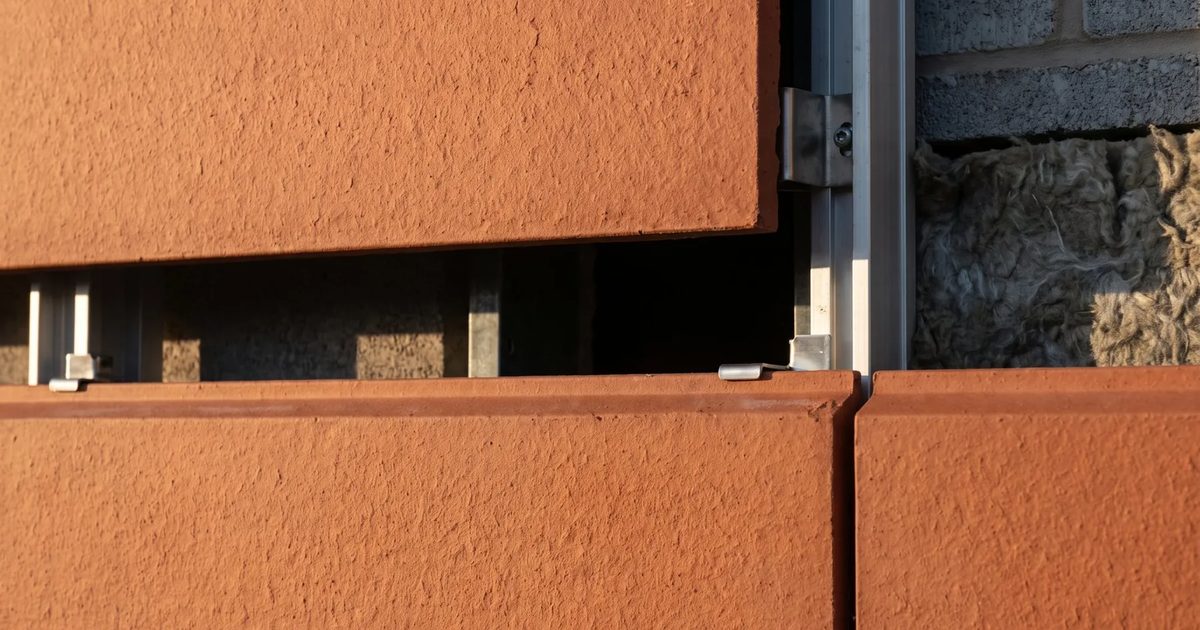
Neither figure describes a fixed property of ventilated façades in general. Both describe what happens when the cavity width, the size and position of the ventilation openings, the cladding material, and the orientation of the wall are set up to work together. Change one of those variables and the airflow inside the cavity changes, which changes how much heat reaches the inner wall.
This is why both papers report a range or a best case rather than a single guaranteed number. A ventilated façade is a system, not a material. Its performance depends on the detailing decisions made during design, and on how carefully those details are executed during construction.
What this means for a building in Egypt
Egypt's climate, hot and largely arid across much of the country, matches the conditions the CFD simulation modeled. That makes the second study directly relevant to the local context, though a simulation of one wall configuration is not the same as a measurement taken on a completed building.
What both studies agree on is the direction: correctly detailed ventilated façades reduce the heat reaching the inner wall and, through that, the load placed on cooling systems. Whether a given building lands closer to 20 percent or to 55 percent, or falls outside that range altogether, depends on decisions made at the design and construction stage, not on the façade system by itself.
For anyone evaluating a ventilated façade for a specific building, the two studies referenced here, Cuce and Cuce in Processes and Alyahya, Lannon and Jabi in Buildings, are a reasonable starting point for working out which detailing questions to ask before assuming either figure applies to that building.
Back to the site