From the field
What actually happens inside a ventilated façade
A plain explanation of how the air gap behind a building's outer panels carries heat away before it reaches the wall, with no fans and no electricity involved.
Three layers, one gap
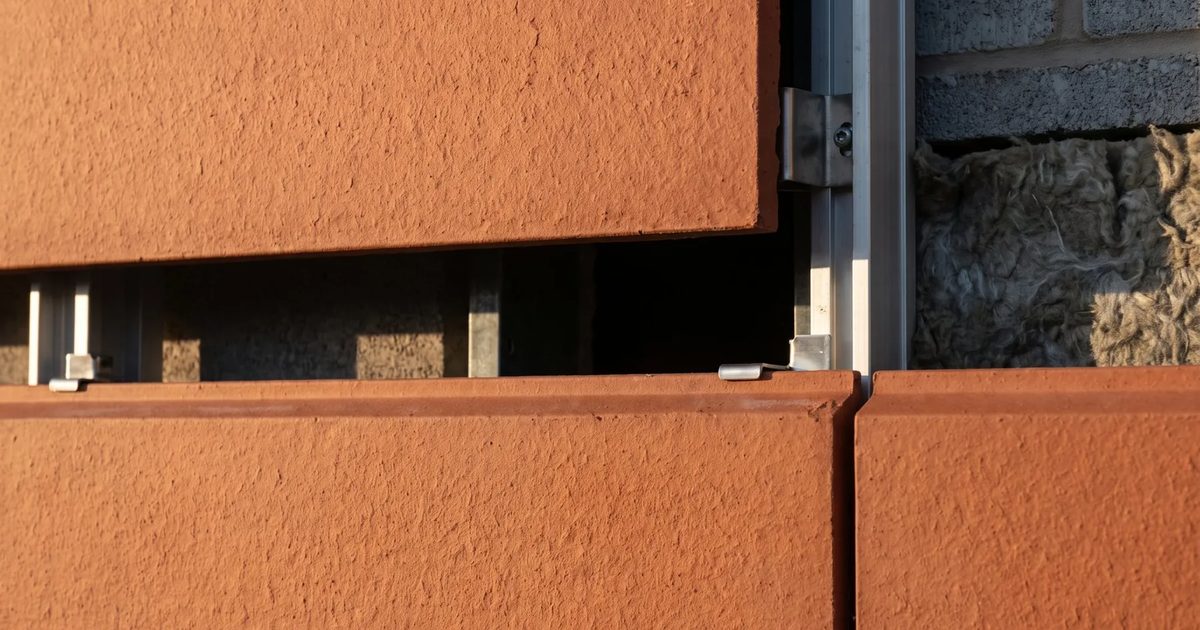
A ventilated façade is built from three parts that each do a different job: an outer cladding panel, a cavity of air behind it, and the insulated wall of the building itself. The cladding is what you see from the street. The wall is what actually holds the building up and keeps the inside separate from the outside.
Between them sits the cavity, and this is the part that does the work most people don't notice. It isn't sealed. It's open at the bottom, where the wall meets the ground or a floor slab, and open again at the top, near the roofline. That opening at both ends is what makes everything else possible.
The outer panel takes the direct hit
When sunlight hits a building, something has to absorb that radiation. In a wall built the ordinary way, it's the wall itself, and the heat it absorbs works its way inward. In a ventilated façade, the outer panel sits in front of the wall and takes that hit instead. The sun lands on the cladding, not on the insulated wall behind it.
The panel does get hot. That's expected and not a problem, because the panel isn't the part of the building anyone lives inside of. What matters is what happens to that heat next, and that's where the air gap comes in.
How the air starts moving without any help
The panel heats the air sitting in the cavity right behind it. Warm air is lighter than cool air, so it doesn't stay still. It rises, the same way it rises above a radiator or a sun-warmed rooftop. As it rises, it moves up through the cavity and exits through the vents at the top.
That departure has a consequence: it leaves room at the bottom of the cavity, and cooler air is drawn in through the base vents to take its place. This new air then gets warmed in turn, rises, and leaves as well. The cycle keeps going on its own, driven by nothing more than the temperature difference between the air near the hot panel and the air outside.
No fans, no electricity, no moving parts
This whole exchange runs without any mechanical push. There's no fan blowing air through the cavity and no electrical system controlling it. The movement comes from physics alone: warm air rises, cool air replaces it, and the cycle repeats for as long as the sun keeps heating the outer panel.
The one condition this depends on is that the gap actually stays open and connected from bottom to top. If the cavity is blocked, poorly sized, or interrupted, the air inside has nowhere to go, and the exchange that carries the heat away doesn't happen the way it's meant to.
The wall that never sees the sun
Because the outer panel intercepts the radiation and the cavity carries the resulting heat away before it builds up, the insulated wall behind it is never touched by direct sun. It sits behind two layers that are doing the work of managing heat before it reaches that surface at all.
This is the basic mechanism, and it's the same mechanism regardless of the building it's applied to. What changes from one project to another is the design of the panel, the depth and continuity of the cavity, and how the vents are placed, all of which are engineering decisions made for the specific wall in question.
EGY Green by Italy is being established, as part of EGY Holding, to bring this type of façade system to buildings in Egypt, drawing on the group's construction experience in Italy; if you're planning a project and want to understand whether this mechanism applies to your building, that's a conversation worth having early, while the wall design is still open.
Back to the site